
October SAT Predictions 2026: 10 Question Types to Review Before Test Day
By Laura Whitmore
If you’re taking the SAT on October 3, this is your final stretch—and no, that does not mean you need to relearn every SAT concept between now and test day.
What is worth doing? Reviewing the question types College Board seems particularly interested in right now. College Board released 270 new questions to its Question Bank in August, and I went through every single one of them. From that set, I pulled 10 concepts and question structures that appear repeatedly and that I think October test takers should be especially comfortable with.
These are predictions—not leaked questions and definitely not a guarantee that all 10 will appear on your specific form. The value is in recognizing the patterns behind the questions so that when College Board changes the numbers, names, or wording, you still know what to do.
Don’t feel like reading? 👉 Watch the full YouTube video here where I walk through each problem step-by-step.
🔮 Prediction 1: Sentence Boundaries That Look More Complicated Than They Are

I would be very surprised if you made it through the October SAT without seeing a boundaries question. You’ll recognize these because the prompt asks about the conventions of Standard English, while the answer choices contain different punctuation marks—periods, semicolons, commas, colons, or combinations of them.
Start with the answer choices
Before getting lost in the passage, ask: Which answer choices are capable of separating two complete sentences?
If only one answer contains punctuation that could correctly join two independent clauses, that answer deserves your attention first. Then test it.
Do not stop reading too early
This is where students get trapped. One side of a boundary may begin with a long introductory phrase that looks incomplete. If you stop halfway through it, you may decide there is no complete sentence there. Keep reading.
Find the actual: subject + verb + complete thought
In the example, the material immediately following the boundary initially looks like a long descriptive phrase, but the true sentence appears later with: these elected officials as the subject and take turns as the verb.
October takeaway
Do not judge sentence completeness by how the first five words look.
Read far enough to find the real grammatical structure.
A complicated introduction can still lead into a perfectly complete sentence.
🔮 Prediction 2: Similar Triangles + Scale Factors in Different Dimensions

College Board loves similar triangles. But the harder questions often combine similarity with something else—and in this case, that something is scale factor.
The example in the video gives two similar triangles, corresponding side lengths of 8 and 14, and the area of one triangle. The question asks for the area of the other.
First recognize the similarity
You may see:
parallel lines creating corresponding angles,
vertical angles,
a large right triangle split into smaller right triangles,
or another familiar similar-triangle structure.
One especially useful pattern to recognize is a large right triangle with an altitude drawn to the hypotenuse. That creates three similar triangles. If you recognize the structure, do not spend half your available time proving something you already know.
Then watch the dimensions
This is the more important part. If corresponding lengths scale by a factor of: 7/4
then corresponding areas do not also scale by 7/4.
Area is two-dimensional, so: Area scale factor = (7/4)²
And if the question involved similar solids and volume? Volume scale factor = (7/4)³
The October example leads to an area of: 441/4
but the transferable skill is understanding how the scale factor changes when you move from one dimension to another.
Memorize this relationship
Length → k
Area → k²
Volume → k³
That one relationship can solve questions involving triangles, cylinders, spheres, prisms, pyramids, and plenty of other shapes.
🔮 Prediction 3: A Circle Equation That Desmos Won’t Instantly Rescue You From

I love Desmos. I use Desmos. I would also like students to understand that occasionally College Board will hand you a question where Desmos is not the cleanest first move.
This prediction involves a circle equation that is not written in standard form and asks you to use information about the radius to determine an unknown constant.
Know standard form
You should recognize: (x − h)² + (y − k)² = r²
That gives you:
center (h, k)
radius r
If the equation is not in that form, you may need to complete the square.
The completing-the-square rule students forget
When completing the square:
Take the coefficient of the linear term.
Divide it by 2.
Square it.
Add that value to both sides of the equation.
That last part matters. A lot. In the video, I talk about making this exact mistake myself on an official SAT because I had gotten so comfortable letting Desmos handle circle questions that doing one by hand caught me off guard. Consider this your reminder not to become too calculator-dependent.
What matters most
Once you complete the square, you may not even need to fully simplify the center if the question only asks about the radius. Focus on the piece the question actually wants.
For the example in the video, that ultimately leads to: t = 71.
🔮 Prediction 4: A Transition Question Where Contrast Is Correct

My next prediction is that you will see at least one transition question where the correct relationship is contrast.
You know the usual suspects:
however
nevertheless
by contrast
on the other hand
But identifying the vocabulary is the easy part. The real skill is deciding whether the two ideas actually contrast.
Read the relationship—not individual words
In the video example, a poet is described as usually adhering closely to traditional sonnet conventions. Then another sentence explains that in one poem, he subverts those conventions.
That is a clear shift:
usually follows the conventions → deliberately breaks the conventions
So a contrast transition fits.
Module 2 can be sneakier
On harder questions, read more than just the two sentences immediately touching the blank. Sometimes the first sentence of the passage gives important context that changes how you interpret the relationship later. And do not decide that two sentences contrast simply because one contains a “positive-sounding” word and the other contains a “negative-sounding” one. You need to understand what the sentences are actually saying.
Your transition strategy
Ask: Is the second idea continuing, contrasting, explaining, illustrating, or showing cause/effect?
Determine the relationship first. Choose the transition second.
🔮 Prediction 5: Trigonometry Hidden Inside Similar Triangles

Yes, I think you should be ready for trig. College Board did, after all, create an entire Math domain called Geometry and Trigonometry. They are probably going to use it.
The example in the video combines:
a right triangle,
an altitude creating smaller triangles,
similar triangles,
a trig ratio,
and a recognizable Pythagorean triple.
Start by drawing the triangle
When you see:
sin, cos, or tan
you should immediately start thinking about a right triangle.
Then label:
SOH → sin = opposite/hypotenuse
CAH → cos = adjacent/hypotenuse
TOA → tan = opposite/adjacent
Learn the common triples
The example uses the ratio from a: 5–12–13 triangle
You should also be very comfortable with: 3–4–5
Recognizing a Pythagorean triple can save you from doing unnecessary calculations.
Do not let an extra number distract you
College Board loves giving you information that is technically correct but unnecessary.
In the example, a side length of 19 appears, but you do not actually need to calculate all of the corresponding physical side lengths. Because similar triangles preserve the same ratios, you can work with the reduced 5–12–13 relationship instead.
That leads to: tan B = 12/5.
The lesson
Before using every number College Board gives you, ask: Do I actually need this?
Sometimes the hardest-looking SAT problems become easy once you ignore the bait.
🔮 Prediction 6: Subject-Verb Agreement

Some SAT question types just refuse to retire. Subject-verb agreement is one of them. I would expect to see it again.
Look at the answer choices first
If the choices are different forms of the same verb, immediately consider whether College Board is testing:
verb tense,
subject-verb agreement,
or both.
One quick test is the he/they trick.
Try each verb with: he and: they
The form that behaves differently can help expose the singular verb.
Then strip down the sentence
The example in the video contains:
a long introductory phrase,
a prepositional phrase,
a nonessential clause between commas,
and enough scientific language to convince you that maybe you accidentally opened the MCAT.
Ignore it. The actual grammatical core reduces to: The presence reinforces claims.
The subject is: presence
Singular.
So the verb must be: reinforces.
This is one of the SAT’s favorite tricks
College Board places plural nouns between the true subject and verb: presence of many bacteria ... reinforces
Students see bacteria and choose a plural verb. But the noun inside the prepositional phrase does not control the verb.
Your test-day move
Cross out:
prepositional phrases,
nonessential clauses,
descriptive interruptions.
Put the true subject next to the verb. Suddenly, the sentence is much less intimidating.
🔮 Prediction 7: Interpreting Exponential Functions
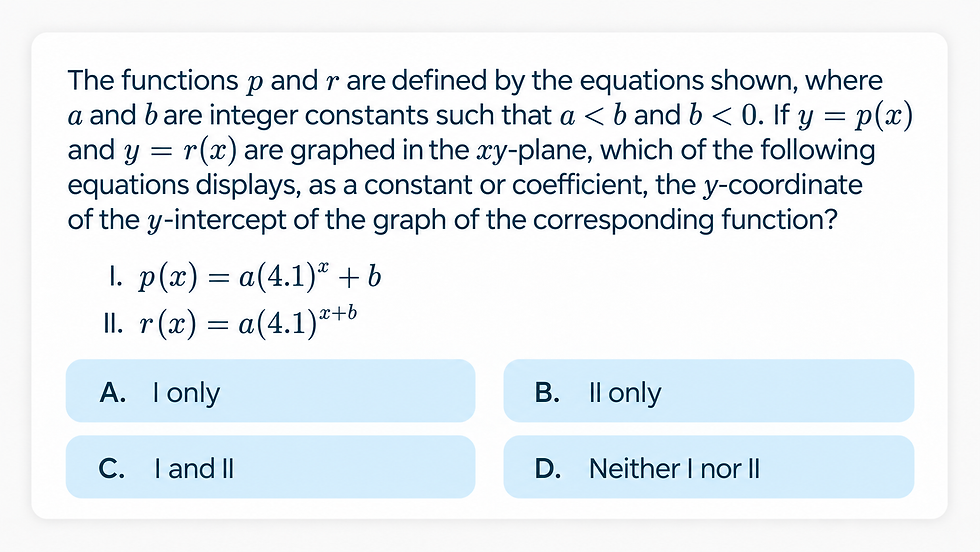
This is one of the more strangely worded Math question types. College Board may give you several equivalent forms of an exponential equation and ask which one displays a particular quantity as a constant, coefficient, or base. That wording throws students. But the underlying idea is simpler.
Translate the question into an input
If they ask about the y-intercept, immediately think: x = 0
Then substitute 0 into each form.
What does the equation simplify to? The question is asking whether the desired quantity becomes something you can directly see in the original expression—for example, a coefficient, constant, or base.
Do not get intimidated by the wording
“Displays as a constant or coefficient the y-coordinate of the y-intercept” sounds like something written specifically to make a teenager reconsider college. Translate it.
Y-intercept → x = 0.
Plug it in. See what remains. In the example from the video, neither proposed equation displays the requested value in the required way, so the correct conclusion is neither I nor II.
What to review
Whenever you see function interpretation questions, know these instantly:
y-intercept → x = 0
x-intercept → y = 0
initial value of an exponential → usually evaluate at x = 0
That translation is often half the problem.
🔮 Prediction 8: Colons and Semicolons in the Same Sentence

Yes. A sentence can contain a colon and multiple semicolons. Everyone survives. This prediction focuses on one punctuation structure students often misinterpret: semicolons being used inside a complex list, rather than simply separating complete sentences.
Semicolons have another job
You probably learned: semicolon = separates two independent clauses
Correct.
But semicolons can also separate items in a complicated list—especially when those individual items already contain commas.
For example: The study included Albany, New York; Austin, Texas; and Portland, Oregon.
The semicolons prevent the list from becoming comma soup.
Where does the colon come in?
A colon can introduce that list when a complete sentence appears before it.
The structure is: Complete sentence: item one; item two; item three.
That is exactly the kind of structure being tested in the video example involving a list of exoplanets. The sentence before the colon is complete, and everything after it expands on that sentence with specific examples.
October takeaway
When you see multiple semicolons in the same sentence, stop automatically treating each one as a sentence boundary.
Ask: Are these separating items in a list?
College Board absolutely tests this.
🔮 Prediction 9: Equivalent Expressions That Are Too Messy for Sliders

Normally, when the SAT asks about equivalent expressions, I am the first person to say: Put both in Desmos. Make the graphs overlap. Go live your life.
But Prediction 9 is a reminder that Desmos sliders are not always the cleanest approach. The example contains an advanced algebra expression that can be factored in two ways, with four different unknown constants—some integers and some non-integers. Trying to manipulate four sliders would be possible in the same way assembling IKEA furniture in the dark is possible. There is a better route.
Turn the factorization into a system
When multiplying: (3x² + c)(2x² + d)
the constant terms must multiply to the original constant, while the cross-products must create the middle coefficient. That gives you two relationships.
Instead of guessing random decimals, turn those relationships into a system of equations.
Then? Open Desmos. This is the important distinction: Desmos is still useful. You are just changing what you ask Desmos to do. Instead of forcing sliders onto the original expression, use Desmos to solve the system. That produces both the integer and non-integer possibilities, and the example ultimately gives: a + c = 15.5.
The larger strategy
Do not become loyal to one calculator technique. Students sometimes learn one Desmos trick and try to force every problem through it. Use the tool that matches the structure:
graph,
regression,
slider,
system,
table,
intersection.
Flexibility beats memorizing one hack.
🔮 Prediction 10: Infinitely Many Solutions

My final October prediction is another SAT classic: infinitely many solutions
You may see this with two equations or with a graph and an equation. The important idea is incredibly simple: Infinitely many solutions means the exact same line
If two linear equations have infinitely many solutions, their graphs completely overlap.
They have:
the same slope,
the same y-intercept,
and ultimately represent the same equation.
So if you can determine one line’s equation, your job is to make the other equation equivalent to it. The example in the video gives line g graphically and defines line k as: 165x + py = w
with unknown constants p and w.
Rather than trying to solve some mysterious “infinitely many solutions formula,” find the equation of the graphed line and make line k match it. Once the lines overlap exactly, the constants are determined.
In the example:
p = 150
w = 150
so: p + w = 300
Memorize these three system patterns
One solution → lines intersect once
No solution → parallel lines
Infinitely many solutions → same line
That relationship should be automatic by test day.
Desmos Is Powerful—But Knowing When Not to Use It Matters Too
Some questions are perfect for Desmos. Others are not.
For the circle question, completing the square is cleaner.
For the equivalent-expression question, a system in Desmos works better than four sliders.
For the infinitely-many-solutions question, understanding what the graph means comes before touching the calculator.
That is the next level of Digital SAT Math preparation.
Not merely asking: “Can Desmos solve this?”
but:“What is the fastest reliable way to solve this?”
Those are different questions.
💡 Final Thoughts
These are predictions—not leaked October SAT questions and not a promise that every one will appear on your test. They are based on recurring patterns in the newest College Board Question Bank questions and the kinds of concepts we have continued to see emphasized on recent Digital SATs.
If you want one final strategy review before test day, join our 2-Hour October SAT Advanced Review Crash Course on September 26th. We’ll focus on challenging SAT question types, high-level strategies, and ways to improve your speed and efficiency before test day. You’ll also receive curated notes and access to the session recording so you can review everything again before the SAT. REGISTER HERE →
If you’re looking for more individualized support, Strategic Test Prep also offers 1:1 SAT tutoring tailored to your specific strengths, weaknesses, score goals, and timeline. Our tutors can help identify exactly what is keeping your score from moving and build a targeted plan around the areas where you can make the biggest gains! BOOK A 15-MINUTE CONSULTATION →
Good luck—and happy prepping!


On a separate note, thank you for Prediction 9 and its explanation. I did not initially figure this one out. Your explanation was very helpful.
Hi. There appears to be a typo in Prediction 5. Where you wrote: "the measure of angle XYZ is b°", I believe you meant: "the measure of angle XYR is b°". That is how it is written in the accompanying YouTube video. Actually, when I watch yhe video explanation, I believe the setup of this question may be wrong. I think you need to make either Angle RXY or Angle RYZ equal to b°. You may want to rework this question on both this page and on the Youtube video.