
10 August SAT Predictions: What Students Should Be Ready to See
By Laura Whitmore
The August SAT is coming up fast, and if you’re wondering what deserves your attention during these final days of preparation, this is where pattern recognition becomes especially useful.
After years of working with SAT students and closely tracking the types of questions that continue to appear, I’ve put together 10 predictions for the August SAT—including nine Math question types and one English grammar pattern I think students should be ready to handle.
These are predictions, not guarantees. But they are based on question types and concepts we’ve been seeing repeatedly, which makes them valuable practice whether or not the exact format appears on your test. Students need to recognize how familiar concepts can be disguised, choose efficient strategies, and know when tools like Desmos can save valuable time.
Don’t feel like reading? 👉 Watch the full YouTube video here where I walk through each problem step-by-step.
🔮 Prediction 1: Right Square Pyramids

Geometry is one of the easiest places for strong students to lose time because a question can look much more complicated than the underlying math actually is.
One type I’ve been seeing more often involves a right square pyramid, particularly questions that require students to distinguish between:
the base area,
the triangular faces,
the slant height,
and the actual vertical height of the pyramid.
WHAT STUDENTS SHOULD KNOW
The first thing I recommend doing is drawing the pyramid. The base is a square with an area of 36, so each side has a length of: √36 = 6
The four congruent triangular faces have a combined area of 12√73, so the area of each triangular face is: 12√73 ÷ 4 = 3√73
Find the slant height
Use the triangle area formula: A = ½bh
Substitute the values: 3√73 = ½(6)(ℓ)3√73 = 3ℓℓ = √73
So the slant height is √73.
Remember: the slant height is not the actual vertical height of the pyramid.
Find the vertical height
Half the width of the square base is 3. Now use the Pythagorean theorem: 3² + h² = (√73)²9 + h² = 73h² = 64h = 8
Answer: 8 inches
THE BIG TAKEAWAY
Draw the pyramid.
Do not try to visualize this entirely in your head. Most mistakes happen because students confuse the slant height with the vertical height. Separating those two measurements before you begin makes the problem much easier.
🔮 Prediction 2: Factoring With an Unknown Integer

Factoring questions are still very much worth reviewing, especially when the SAT introduces an unknown positive integer into one of the factors.
In this example, the problem tells you that x + 3b is a factor, where b is a positive integer.
The answer choices are quadratic expressions beginning with 2x² and ending in 24b.
That tells us the other factor must have the form: 2x + 8
Why? x(2x) = 2x² and 3b(8) = 24b
Now look at the full factorization: (x + 3b)(2x + 8)
The middle terms are: 6bx + 8x
The key is determining which answer choice produces a value of b that is actually a positive integer.
For the working choice: 6bx + 8x = 44x6bx = 36xb = 6
Because 6 is a positive integer, that choice works.
Answer: D
WHAT STUDENTS SHOULD WATCH FOR
The SAT may not ask you to fully factor a polynomial.
Instead, it may give you one factor and ask which expression could work under a condition such as: b is a positive integer.
That condition matters just as much as the algebra.
🔮 Prediction 3: Factoring Shortcuts for the Greatest Possible Middle Term

The next prediction is another factoring problem, but this one is designed to test whether you recognize a pattern quickly enough to avoid a long solution.
The expression is: 30k¹⁶ + bk⁸ + 28
One useful way to make the structure easier to recognize is to temporarily think of k⁸ as one variable.
Then the expression behaves like: 30x² + bx + 28
The problem asks for the greatest possible value of the middle coefficient.
For this particular structure, the shortcut highlighted in the video is: multiply the outside terms and add 1. So: 30 × 28 = 840840 + 1 = 841
Answer: 841
WHY THIS MATTERS FOR HIGH SCORERS
The important point is not simply memorizing 841. It is recognizing the factoring structure quickly enough that you do not spend a full minute rebuilding the expression from scratch.
Saving 45–60 seconds here gives you that time back for a difficult geometry or advanced algebra question later in the module. Efficiency is part of scoring well on the Digital SAT.
🔮 Prediction 4: Exponential Growth Wording

Exponential-growth questions are often less about difficult math and more about carefully interpreting the language.
One phrase to watch closely is: increases by 240%
A 240% increase does not mean the multiplier is 2.4.
You need to include the original 100%: 100% + 240% = 340%
Convert that to a decimal: 340% = 3.4
So the growth factor is: 3.4
Now pay attention to the timing language.
If the quantity increases every 15 days, the number of growth periods after x days is: x ÷ 15
So the exponential part of the model should be: 3.4^(x/15)
not: 3.4^x
WHAT TO REMEMBER
For exponential models, identify two things immediately.
Growth factor: 1 + rate
Number of growth periods: time ÷ length of one growth period
A lot of SAT exponential questions become much easier once those two pieces are identified.
Also pay attention to the wording: “every 15 days” is not the same as “each day for 15 days.” On SAT Math, one small phrase can completely change the exponent.
🔮 Prediction 5: Translating a Multi-Part Word Problem Into One Equation
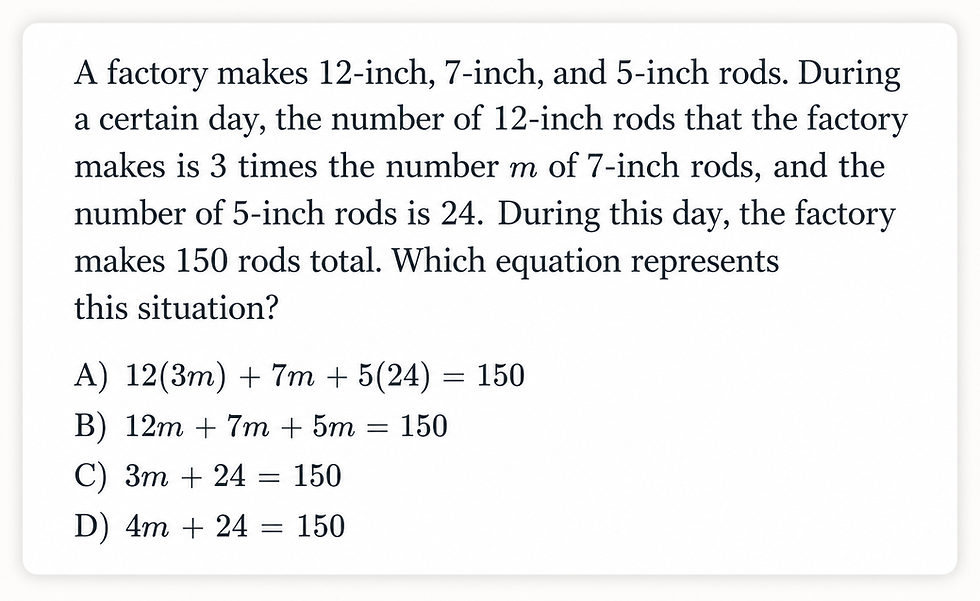
This question structure has been showing up frequently: several categories are described in words, and students need to create the equation that correctly represents the situation.
In this example, a factory produces:
12-inch rods,
7-inch rods,
5-inch rods.
Let m represent the number of 7-inch rods.
The number of 12-inch rods is three times that amount: 3m
The number of 5-inch rods is: 24
There are 150 rods total, so add the quantities: 3m + m + 24 = 150
Combine like terms: 4m + 24 = 150
Answer: D
WHY STUDENTS GET CAUGHT HERE
There are three types of rods, so students often assume there must be three separate variable terms.
But two of the quantities are related: 3m + m = 4m
Also notice that 12, 7, and 5 describe the lengths of the rods. They are not numbers you automatically multiply into the equation.
Always ask: What does the variable actually represent?
That one question can prevent a lot of unnecessary errors.
🔮 Prediction 6: Random Assignment and Cause-and-Effect

Expect statistics and experimental-design questions to continue appearing.
One especially important distinction is: When can a study attempt to establish a cause-and-effect relationship?
The key is random assignment. If researchers want to determine whether a treatment causes an outcome, subjects need to be randomly assigned to treatment conditions.
Answer: C
DO NOT CONFUSE RANDOM ASSIGNMENT WITH RANDOM SAMPLING
These concepts serve different purposes. Random sampling helps researchers obtain a sample that is more representative of the larger population and supports generalization. Random assignment helps researchers compare treatment groups and establish cause-and-effect relationships.
For SAT purposes, remember: Cause and effect → random assignment
That distinction can turn a lengthy-looking statistics question into a 10-second point.
🔮 Prediction 7: Scale Factors Across Different Dimensions

This is one of the most important geometry concepts for high-scoring students. If two similar solids have different volumes and surface areas, you cannot simply set up one direct proportion and assume everything changes by the same factor.
Why?
Because:
length is one-dimensional,
surface area is two-dimensional,
volume is three-dimensional.
Start with the volume ratio
In the example: 4.32 ÷ 2.50 = 1.728
Because volume is three-dimensional, take the cube root to find the linear scale factor: ∛1.728 = 1.2
So corresponding lengths scale by: 1.2
Convert the scale factor to surface area
Surface area is two-dimensional, so square the linear scale factor: 1.2² = 1.44
Cylinder A has a surface area of 18.72 square units.
Cylinder B is smaller, so divide: 18.72 ÷ 1.44 = 13
Answer: 13 square units
MEMORIZE THIS RELATIONSHIP
If the linear scale factor is k:
Length factor = kArea factor = k²Volume factor = k³
This same relationship can appear with cylinders, spheres, prisms, pyramids, and other similar solids.
The biggest mistake is using a direct proportion between volume and surface area. They are measurements in different dimensions, so they do not scale at the same rate.
🔮 Prediction 8: Working Backwards on Complicated Discount Problems

Some SAT word problems are technically solvable with algebra—but algebra is not always the smartest strategy.
The jacket-discount problem in the video is a great example.
An online store:
charges $60 per jacket,
offers an n% bulk discount when n jackets are purchased,
takes another $6 off each jacket,
and gives answer choices for the number of jackets purchased.
Instead of building a complicated equation immediately, work backwards from the answer choices.
Start with a middle answer choice
Suppose: n = 20
That means the bulk discount is 20%.
Twenty percent of $60 is: 0.20 × 60 = 12
So after the bulk discount: $60 − $12 = $48
Then apply the additional $6 discount: $48 − $6 = $42
Now multiply by the 20 jackets: 20 × $42 = $840
That matches the total in the problem.
Answer: B — 20 jackets
A USEFUL SAT STRATEGY
When the question gives you numerical answer choices and setting up the algebra feels unnecessarily messy: plug the answers back in.
Starting with B or C is often especially useful because if your result is too high or too low, you may immediately know which direction to move.
Remember: the SAT does not award extra points for using the fanciest algebra.
Use the method that gets you to the correct answer efficiently and reliably.
🔮 Prediction 9: Let Desmos Handle Function Constants

This is another question where understanding what Desmos can do may save a lot of time.
The problem defines two functions:
f(a) = (a² + 10a + 25)(a + 2)
g(b) = b(b + 3)(b − 2)²
It then tells us: f(4) = c
Find c
Substitute 4 into the function: f(4) = (4² + 10(4) + 25)(4 + 2)
Simplify f(4) = (16 + 40 + 25)(6)f(4) = 81 × 6c = 486
Now evaluate the input for g: c ÷ 81 = 486 ÷ 81 = 6
So: g(6) = 6(6 + 3)(6 − 2)²
Simplify: g(6) = 6(9)(4²)g(6) = 6 × 9 × 16g(6) = 864
Answer: 864
WHERE DESMOS COMES IN
You can also define both functions directly in Desmos and let the calculator evaluate the expressions for you.
A lot of students use Desmos only for graphing.
Top scorers should also be comfortable using it for:
regressions,
defined functions,
constants,
intersections,
systems,
and evaluating nested expressions.
The Digital SAT gives you Desmos. Learn how to make it work for you.
🔮 Prediction 10. A Long Grammar Sentence With a Hidden Main Verb

Yes—my final August prediction is an English question.
This one is aimed at the later part of Module 2, where sentences can get significantly longer.
The sentence contains a subject early on: research
and its main verb much later: invites
Everything between the subject and the main verb is additional descriptive information.
That means the correct choice is: revealing
because it functions as part of a descriptive phrase instead of creating another competing main verb.
Answer: B — revealing
THE BEST STRATEGY: DELETE THE EXTRA INFORMATION
Strip the sentence down to its grammatical skeleton:
Whose research invites a broader reconsideration of the era’s visual culture.
That is already a complete grammatical structure.
Subject: research
Verb: invites
So the material in between is additional information describing the research.
This is one of the most useful SAT grammar habits you can develop:
Find the subject. Find the main verb. Temporarily remove everything between them.
A sentence can be 40 words long and still have a very simple grammatical foundation.
💡 Final Thoughts Before the August SAT
What These August SAT Predictions Tell Us
The biggest theme across these predictions is that the SAT is not simply testing whether students know algebra or geometry. It is testing whether they can recognize how a familiar concept is being disguised.
A student may already know the Pythagorean theorem but miss a pyramid question because they confuse slant height and vertical height. They may understand percentages but misinterpret “240% increase.” They may know experimental design but forget the difference between random sampling and random assignment. They may know how to solve equations but waste two minutes building one when plugging in the answer choices would take 30 seconds.
That distinction becomes especially important for students targeting scores in the 1400s and 1500s.
How to Use These Predictions Before Test Day
Do not try to memorize the answers to these 10 examples.
Instead, make sure you can recognize the underlying patterns:
Pyramid? Draw the figure and distinguish slant height from actual height.
Factoring with integers? Pay attention to the condition on the factor.
Percent increase? Add the original 100%.
Exponential model? Identify the growth factor and time interval.
Experimental study? Cause and effect means random assignment.
Similar solids? Match the scale factor to the dimension.
Ugly word problem with answer choices? Consider working backwards.
Functions and constants? See whether Desmos can simplify the work.
Long grammar sentence? Find the subject and main verb first.
Those strategies transfer to new questions even when College Board changes the numbers or context.
These are predictions, not a leaked test or a guarantee of what will appear on the August SAT.
But if you are preparing for the August test, these are exactly the kinds of patterns I would want to be comfortable with before walking into the exam.
We have free SAT English and Math workbooks available, along with the newly compiled question-bank practice mentioned in the video.
And if you want more personalized preparation, Strategic Test Prep offers one-on-one tutoring. Fill out a consultation request on our website, and our team can help determine the best preparation plan for your goals.
Good luck on the August SAT—and happy prepping!


Preparing for standardized exams like the SAT requires rigorous planning and precise timing strategies. Outside of test-taking, students and young adults often look for quick, digital tools to solve everyday logistical puzzles—like figuring out jewelry dimensions for gifts or personal wear. Utilizing a convenient ring size calculator online helps determine exact dimensions seamlessly without needing physical tools. Excellent breakdown of the upcoming test predictions!
Got recommended Arena King by a coworker and the strategy games on there are pretty engaging. You can sink a surprising amount of time into the kingdom-building ones. Runs well in the browser without needing to download anything.
Me parece útil que los resultados puedan consultarse sin tener que recorrer demasiadas páginas. Cuando alguien busca el resultado loteria, normalmente necesita encontrar una información concreta y verificarla rápidamente. Una presentación organizada por fechas y números facilita bastante esta tarea y hace que la experiencia de consulta sea mucho más cómoda.
Would be interesting to compare these predictions with the actual August test. @acceleration city
The timing part is honestly harder than I expected. TAG game