
May SAT 2026 Predictions: What to Expect and How to Prepare
- Apr 22
- 4 min read
By Laura Whitmore
If you’re taking the May SAT, preparation isn’t just about reviewing content—it’s about understanding patterns. Recent exams have shown clear trends in both the English and Math sections, and students who recognize these patterns can move faster and avoid common traps.
Let’s walk through the most important predictions and how to approach them with confidence.
English Section: Precision Over Speed
A New Twist on Transitions
One emerging trend is transition questions that include full phrases—not just single words like “however” or “therefore.” The key here is not to focus on the transition itself, but on the phrase that follows it.
Instead of asking, “Which transition fits?” ask yourself, “Which idea logically leads into the next sentence?” Read ahead, identify the continuation of thought, and choose the option that sets it up most clearly.

Why the “-ing” Form Matters
Expect at least one grammar question where the correct answer uses the -ing form. These often appear when extra descriptive information is placed between the subject and the main verb.
A reliable strategy is to identify the core sentence first:
What is the subject?
What is the main verb?
Anything in between is usually additional information. If a verb appears in that section, it should typically be in the -ing form so it doesn’t compete with the main verb.

Understanding Modifier Questions
Modifier questions—often called “lead-ins”—are another high-probability topic. These begin with a descriptive phrase followed by a comma, then a blank.
The rule is straightforward: the subject must match the description. If the opening phrase describes a specific object or idea, the very next noun must clearly be that thing. If it isn’t, the sentence becomes illogical.

Comma Placement Made Simple
A common grammar trap involves unnecessary commas, especially when a title comes before a name.
If a sentence flows naturally without a pause, you likely don’t need commas. When in doubt, choose the option with fewer commas—it’s often the correct one.

Math Section: Recognizing Patterns Quickly
When to Use Regression
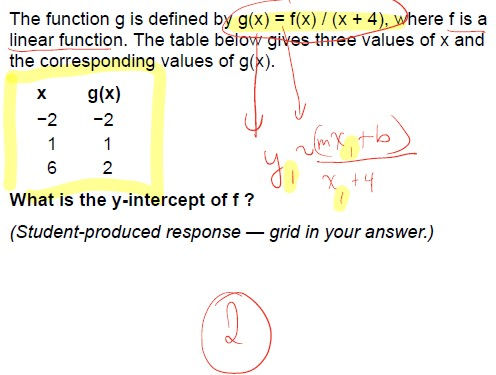
You may encounter a rational function with an unknown linear numerator. These questions often include both an equation and a table of values—a strong signal that regression is the best approach.
Using tools like Desmos effectively can save time and reduce error. The key is setting up the regression correctly and interpreting the parameters, especially when asked for something specific like a y-intercept.
Linear Equations with a Twist
A recurring challenge involves piecewise-style pricing problems, where different rates apply to different groups.
The trick is to separate the fixed portion from the variable portion:
First, calculate the guaranteed total from the initial group.
Then, add the cost for the remaining group—but only after subtracting those already counted.
Missing that subtraction step is a common mistake.

Exponential Growth and Decay
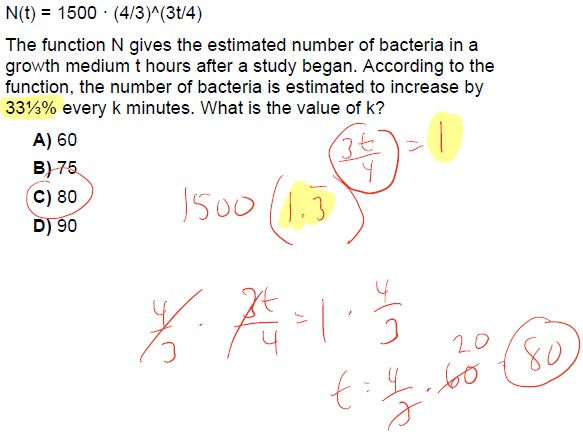
Exponential functions are almost guaranteed to appear. You should be comfortable identifying:
The initial value
Whether the function represents growth or decay
The rate of change
The time interval
Be especially careful with units. If the question gives time in hours but asks for minutes, you’ll need to convert your answer before selecting a choice.
Expect Trigonometry
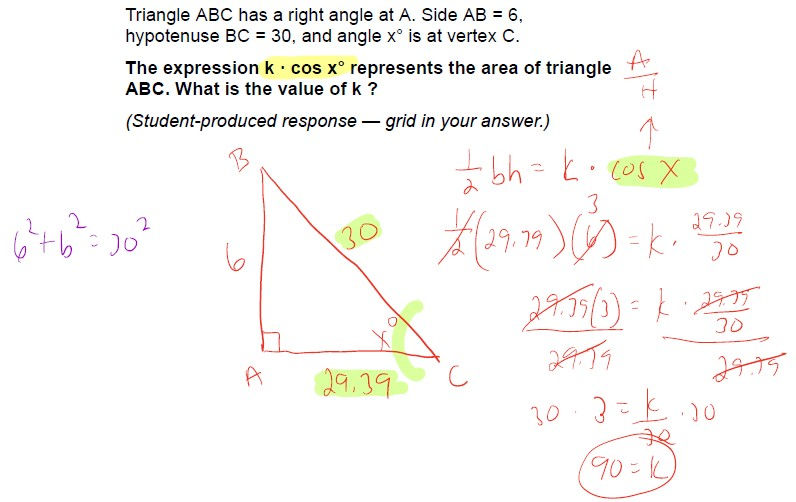
Trigonometry is almost guaranteed to appear. Even when the problem seems complex, it often comes down to basic relationships between sides of a triangle.
Drawing a diagram—even a rough one—can make a huge difference. Once you identify which sides you’re working with, choosing the correct trig function becomes much easier.
Exponents and Function Notation
Another likely appearance is a question combining exponent rules with function notation.
These problems test whether you can:
Translate function notation into expressions
Apply exponent rules correctly
Simplify efficiently
Once set up properly, these questions are often straightforward.

Right Triangles and Trig Ratios
One of the most consistent SAT patterns right now is the right triangle setup where you’re asked to express a missing side using a trig function.
These questions often give you one side, one angle, and ask for another side—frequently the hypotenuse. The key is recognizing which ratio you need based on what you’re given. If you’re working with the adjacent side and the hypotenuse, you’re in cosine territory. From there, it’s just about setting up the equation correctly and solving.
What makes these tricky isn’t the math—it’s the setup. Many students know SOH-CAH-TOA, but hesitate when they need to rearrange the equation to isolate the variable. The SAT leans heavily on this exact skill.

Final Thoughts: Strategy Over Memorization
The SAT isn’t just testing what you know—it’s testing how you think under pressure. Recognizing patterns, avoiding common mistakes, and approaching each question with a clear strategy can make a significant difference.
As you prepare for the May test, focus on efficiency as much as accuracy. The more familiar these question types feel, the more confident you’ll be walking into the exam.
Stay consistent, keep practicing, and make your final weeks count.
If you’re currently scoring around a 1350 and aiming to break into the 1400–1500+ range, this final stretch can be where the biggest gains happen. At this stage, it’s not about learning more—it’s about sharpening execution and cutting the mistakes that are holding your score back.
The Advanced Review Crash Course this weekend is built for exactly that. We’ll focus on patterns, traps, and the fastest paths through the hardest questions to push into top score territory.
Laura Whitmore is the founder and CEO of Strategic Test Prep. She has 19 years of SAT tutoring experience and scores a 1590 on the Digital SAT.


Excellent advice for anyone preparing for the SAT. Confidence comes from understanding the test, not just memorizing content. Football Bros